












After an investigation by OSHA, a grain elevator business in Illinois was cited $205,106 and placed on the Severe Violator Enforcement Program for failing to provide safety protections to its employees. A worker suffered fatal injuries after falling into a grain bin at its Grant Park facility. OSHA cited the business for two willful and three serious violations. The agency found that the grain operator...
Read More
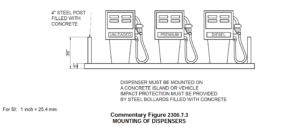
Anyone who follows my ramblings knows that I am a big fan of bollards. I have written about them and shared dozens of incidents where a properly designed and installed bollard saves the day and more often than not I am sharing incidents with “fake” bollards where something was destroyed because the bollard was IMPROPERLY designed and installed. Last Friday we had another bollard...
Read More
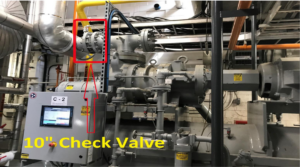
A safety feature(flanged connection)failure in a refrigeration system released 10 to 20 lbs of ammonia intended to be contained.
The ammonia refrigeration system is designed to operate at 250 Psig. The system uses welded or flanged connections to connect components such as compressors, condensers, evaporators, and liquid receivers. Piping and fittings including flanges, different types of valves, elbows,...
Read More
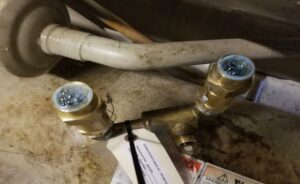
PSM/RMP covered processes that operate above 15 psi will have relief valves to protect pressure containing components such as vessels, piping, pumps, compressors, etc. It is standard practice that these relief valves get changed out at least every five (5) years or so; please follow your RAGAGEP and/or the RV manufacturer instructions for specific change/test schedules. But whenever we...
Read More
Immediate Action Required
During a recent internal review, 3M discovered a potential issue involving certain versions and lots of the size-medium 3M™ Half Facepiece Disposable Respirators 5000 Series. In a limited number of instances, we have observed a pinhole in the chin area of the faceseal. This affects only certain 5200 (MEDIUM) respirators that were MANUFACTURED IN JULY 2019, WITH LOT NUMBERS...
Read More
In 2019, OSHA published a respiratory protection guide for Roofing Contractors, but since I do not work in the construction field I did not pay much attention to it. But today I found some never published guidance from OSHA regarding how an employer can establish a “change-out schedule”. I may have missed this in all the other OSHA/NIOSH documents regarding respirators or my...
Read More
I really don’t understand the mindset of these companies… they have a horrible accident, and rather than recognize something failed and needs to be fixed, they hire lawyers to fight all the OSHA citations rather than competent/qualified safety professionals to fix it all. These citations were like “taking candy from a baby” because the company managed respiratory protection...
Read More
OSHA cited a grain, lumber, and supply company for grain-handling safety violations after corn engulfed an employee clearing clumps in a grain storage bin. First responders were able to rescue the worker. The company faces $69,010 in penalties. OSHA cited the company for two willful and four serious violations for exposing employees to engulfment hazards while walking/working on the grain to make it...
Read More
Respondent owns and operates the chemical manufacturing and distribution facility. Anhydrous ammonia is a “regulated substance” pursuant to 40 C.F.R. § 68.3 with a threshold quantity, as listed in 40 C.F.R. § 68.130, of 10,000 pounds. Ammonia in the concentration of greater than 20% is a “regulated substance” pursuant to 40 C.F.R. § 68.3 with a threshold quantity for ammonia...
Read More
A baseline of every 5 years is recommended; however, there are some critical exceptions that would require more frequent inspections. And if the process is CLEAN (e.g., Non-Fouling), we could go 10 years WHEN the manufacturer permits. Here is a breakdown of these frequencies, using API 576 and NB Part 4.
…
HomeRead More »
Read More
ASME B31.3 does not permit the use of an “ASME Section V Pressure Change Test” as a substitute for the mandatory leak testing requirements (hydrostatic, pneumatic, or initial service leak test) defined in Chapter VI of the B31.3 Code.
Why It Cannot Be Used as a Substitute:
…
HomeRead More »
Read More
OSHA may use its General Duty Clause (GDC) to require employers to install oxygen monitors in areas where inert cryogenics are stored or used. But I like to use codes/standards (e.g., RAGAGEPs) to guide my safety engineering for these hazardous processes, even though PSM/RMP does not cover them. To do this, I turn to the International Fire Code (IFC) applicable to my state. Here is the language...
Read More