













Words still mean something! There is a reason why OSHA (and EPA) use the word “Management” in the titles of their process safety standards. Sorry to state the obvious, but the standards are NOT called “process safety managER” for a really good reason. I have been serious about process safety since 1993 and the one thing I have learned…
there is no single...
Read More

SAFTENG Members can get a sneak peek at our presentation before Wednesday. Come and see Jonathan and I present our Top 10 Myths and Misconceptions or to just say Hi and catch up.
Misconception #1 1910.146 applies ONLY to General Industry workplaces and 1926.1201-.1213 applies ONLY to Construction worksites
Misconception #2 Anyone can evaluate a CS to determine...
Read More
Respondent owns and operates a cleaning and maintenance product manufacturing and supply facility where greater than 15,000 pounds of vinyl acetate monomer in a process at its facility. On or about April 4-5, 2017, EPA conducted an inspection of Respondent’s facility to determine compliance with Section 112(r) of the CAA and 40 C.F.R. Part 68. From the time Respondent first had on site greater...
Read More
OSHA has cited a food facility after a worker required medical treatment due to an anhydrous ammonia leak in the packaging house. OSHA found issues with the Emergency Action Plan and Employee Alarm System, RAGAGEP compliance with IIAR standards, PSM Initial and Refresher Training, HAZCOM Training, PSM Incident Investigation Procedures, Lack of an Emergency Response Plan for responding...
Read More
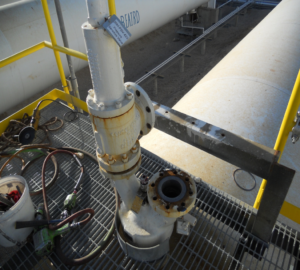
An ammonia storage tank was taken out of service for its 10-year non-destructive examination. After the tank was purged and opened, two (2) contractors were removing two (2) relief valves for their 5-year inspection and tests. The two (2) relief valves are 8 bolt flanged connected to a wye piping fitting equipped with a selector valve (as shown in the picture to the left). The selector valve...
Read More
Back in December 2017, I wrote about a change in the Anhydrous Ammonia fertilizer industry that would most likely require the industry to perform an MOC and PSSR. (A new grade of anhydrous ammonia fertilizer means a MOC, PSSR, etc.) Now that the product has received its official approval and has found its way into the industry, we have learned even more about these additives and how they will impact...
Read More
Below are the items on OSHA’s regulatory agenda. I have posted their scope on the standards that play a major role in the facility’s I do work in and links to all of the other items for those of interest to you.
…
HomeRead More »
Read More
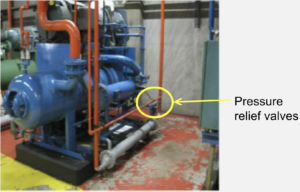
In April 2011, an OSHA State Plan investigated a 3,600-pound ammonia release at a large warehouse where anhydrous ammonia is used in the refrigeration system in a cold storage building. In this incident, one worker was burned on the arm from the escaping gaseous ammonia. As part of the planned mechanical integrity schedule, two (2) employees were changing out the two (2) pressure relief valves...
Read More
Employees #1 and #2 were draining refrigerant oil from anhydrous ammonia refrigeration system oil traps in fruit cold storage warehouse(s). They were working approximately 24 feet above floor level on a mobile scissor lift personnel platform using hand tools including a wrench, a flashlight, and a bucket. The cause of the unexpected ammonia release is unknown. Employees #1 and #2 suffered thermal and...
Read More
At approximately 9:30 p.m. on June 30, 1993, Employee #1, a cleaning contractor, was cleaning up the “cut floor” at a beef facility in Council Bluffs, IA. The facility maintenance employees were removing an ammonia valve from the refrigerant line in the ceiling and had NOT locked or tagged out the isolation valves on the roof. The valve on the cut floor was removed and taken to...
Read More
On December 26, 1989, Employee #1 was attempting to replace a leaking oil valve on a minus 30-degree freezer when a tank inside the freezer exploded. The company uses anhydrous ammonia to manufacture ice cream. The liquid ice cream mixture (at 50 degrees) is added to the tank. When the liquid ammonia changes to a gas, the liquid ice cream mixture becomes solid. As the ammonia gas pressure builds up...
Read More
An oil separator on a two-stage ammonia refrigeration system became overpressurized and exploded, killing Employee #1. While looking for Employee #1 after the accident, Employee #2 fell into a drain. Ammonia that had been uncovered as a result of the explosion had flowed into the drain. Employee #2 was hospitalized.
…
HomeRead More »
Read More