











This video is about as picture-perfect as we can get to show us how static is an ignition source. The plastic rolls (commonly called expandable polystyrene or EPS for short is made with Pentane, a highly flammable CAT 1 gas that is heavier than air and has a Minimum Ignition Energy of just 0.22 mJ. When this EPS is made, it must be allowed to “off-gas” for a period of time,...
Read More
There are very, and I mean like I can can the number of audits on one hand, rare that we do a compliance audit and not have a 1910.157 finding. And the kicker of it… OSHA gives employers options on how they manage their use of fire extinguishers. Bottom line… OSHA does NOT require that fire extinguishers be provided; your insurance company may require or your state fire code...
Read More
I am amazed at how technically incompetent our profession is becoming. I guess I need to praise my old bosses/plant managers once again as I grew up being the safety hero in the plants I worked at. You see, it was NOT my role to drive safety (although I was often the one picking up the flag and leading the charge up the hill in battle). My role was to plot the path and develop the safety process, procedures,...
Read More
Respondent operates a petrochemical manufacturing facility (NAICS Code 32511) that produces vinyl chloride for use in the plastics industry. The production areas represent a single RMProgram covered process involving sixteen (16) RMProgram regulated chemicals. At its stationary source, the Respondent has 27,000,000 pounds of vinyl chloride and 6,700,000 pounds of chlorine. At its stationary source,...
Read More
We debated this topic a couple of years back and although I am not sure we came to an agreement, I was, still am, set on the idea that 1910.146(c)(5) and (c)(7) can NOT be used simultaneously on the same PRCS. In other words, the PRCS either qualifies for (c)(5) entry or (c)(7) entry; or of course, we can do a permitted entry using sections (d)-(k). But a while back we were working a turnaround...
Read More
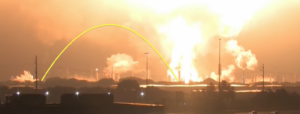
UPDATED on 7/1/2019 – Pics of the tank that “exploded” being recovered from the river
Well, only time will tell, but my best guess from viewing the video footage from several angles is that it appears that a vertical atmospheric storage tank did go airborne and this resulted in a large fireball. I have no idea what was in the tank, but each video makes it appear that this was...
Read More
The information in this report is preliminary and will be either supplemented or corrected during the course of the investigation.
On April 25, 2019, about 4:33 a.m. central daylight time, about 750 gallons (3,800 pounds) of anhydrous ammonia liquefied compressed gas (UN1005, Division 2.2) were accidentally released from two 1,000-gallon nurse tanks mounted on a farm trailer that was being pulled by...
Read More
This week we saw two Canadian businesses be fined over $1.2 M (CAD) for discharging their “Ammonia bleed water” to a storm drain which discharged into a river killing around 70 fish. The business, a University in British Columbia, hired a refrigeration contractor to make repairs to the refrigeration system, at which time the contractor used a negative pressure device, known as a Venturi,...
Read More
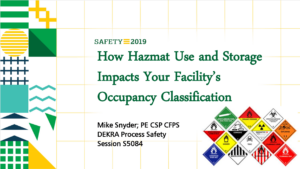
This is a presentation from Safety2019! that was done by one of our longest running corporate sponsor (10+ years), Dow Corning. Mike is now the Executive Vice President, Process Safety (Americas) with DEKRA and quite possibly the best “code pro” when it comes to flammable liquids, especially when they are in Intermediate Bulk Containers (IBC). Mike has provided his SAFETY2019!...
Read More
Respondent owns and operates a controlled temperature storage warehouse. The Facility is located within a mixed business-residential area within half a mile of many businesses and residences. At the time of the EPA inspection, approximately 14,600 pounds in total ammonia was present at the Facility; however, the facility had two (2) separate refrigeration systems, each of which contained approximately...
Read More
As it usually goes, the vast majority of challenges and questions I have received thus far from yesterday’s ASSP2019! Presentation centered around the most controversial characteristic of 1910.146…
4. Contains any other recognized serious safety or health hazard
I could have spent half a day talking about this single characteristic, but I had only 35 minutes. Seems some safety professionals...
Read More
OSHA cited a chemical manufacturer after a chemical release at the manufacturing plant exposed workers to ethylene oxide. The company faces $262,548 in penalties. OSHA initiated an inspection after the exposure hospitalized one employee and left five others suffering symptoms of ethylene oxide (EtO) exposure. The Agency cited 25 serious violations, including deficient emergency action and response...
Read More