











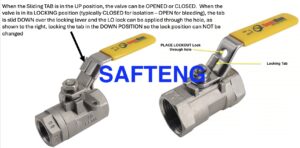
I know many safety professionals will know this, but when we ask operators or “Authorized Employees”, the vast majority have never been trained on the lockout mechanism on these 1/4 turn ball valves!!!
Once we know and we use them, should they be fixed/replaced when we find them broken or missing?
Of course, we can use a different lockout device on the valve. I’m just curious as to how many...
Read More
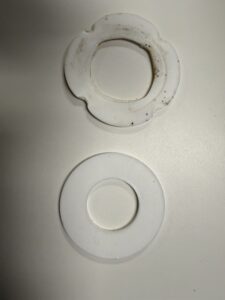
This is what over-torquing looks like on a four (4) bolt flange. The gasket began as the image on the bottom and came out as the image on the top!
And we wonder how flanges leak, and leak again, and eventually fail?
Read More

Several years back, I worked with an organization that had an in-house Operational Testing program with a really catchy name. I actually loved the name, but as I learned more about the process, it was simply a catchy name for a very bad process. It was an attempt by a business to have BOTH a Behavior-Based Safety Process (BBS) and a Skills Testing program required by the government agency that regulated...
Read More
Recently, I had the opportunity to help a client gain the full picture of what has to be done regarding the BULK TRANSFER hoses to unload their HHC/EHS from Tanker Trucks/ISO Containers and Railcars. Now, before we get into the specifics, I know a number of folks will fall back on the compliance position that unloading/loading our HHCs/EHSs are DOT-regulated functions. Through my career, I have learned...
Read More
Last week, David Ayers, Ph.D., CSP, CHMM, and I had a nice chat regarding LOTO and Complex Processes, and one of the areas associated with these LOTOs is the “evacuation” of the HAZMAT within the process/system. We did not have enough time for me to get deep into the weeds on this aspect of isolating a Process/System, so this is my attempt to explain what needs to be done.
1st and most important,...
Read More
In our PSM/RMP and OSH audits, we always spend more time on the Life Safety Standards, such as PRCS, LOTO, LEO, Respiratory Protection, etc. One of the most common errors we find in these audits is the lack of training for the attendants. It’s not that they are not meeting 1910.146(i)(1) – 1910.146(i)(10) training obligations; it’s that they are missing the KEY ROLE most businesses...
Read More
Chemical Process Safety (PSM/RMP)
Flammable Liquids
Flammable Liquids Videos
Free
Hazardous Materials
An explosion at a large outdoor oil storage tank at Korea National Oil Corporation Pipeline’s Yeongnam branch is preliminarily attributed to static electricity generated during a petroleum component verification process. The incident occurred at a large-scale oil storage facility housing 12 to 14 tanks, raising concerns that it could have escalated into a major disaster.
During an on-site briefing,...
Read More
We see this often, handling, storing, and processing a Class IIIA flammable liquid, and about half will classify the area, and the other half do not. So who is right? Here is my take on the matter as I work thru the risk analysis…
…
HomeRead More »
Read More
OSHA has cited a petroleum tank services contractor for exposing workers to chemical and respiratory hazards after an employee was fatally exposed to benzene and toluene when they entered a fuel storage tank in July 2025.
Investigators cited the company with 12 serious violations for failing to develop and implement a written permit-required space entry program, ensure those authorized to enter the...
Read More
Question 1: To what extent does OSHA’s Respiratory Protection standard, at 29 CFR § 1910.134(e), require that the PLHCP’s medical evaluation for respirator use include consideration of factors beyond respiratory protection that affect fitness to safely perform the expected job tasks while wearing a respirator?
Question 2: Is there a reasonable expectation that the employer will provide...
Read More
The Safety Champions Program (SCP) assists employers in developing and implementing a robust safety and health program (SHP). The main goal of safety and health programs is to prevent workplace injuries, illnesses, and deaths, as well as the suffering and financial hardship these events can cause for workers, their families, and employers. The SCP is a voluntary cooperative program and operates separately...
Read More
OSHA has cited a Florida plumbing, heating, and air conditioning contractor for exposing workers to struck-by hazards after an employee suffered a fatal injury at a Bal Harbor Shops worksite in August 2025.
OSHA found that on Aug. 28, 2025, a pipefitter installing a new air-conditioning system for a mall expansion construction project was fatally injured by a pressurized HVAC piping system.
The...
Read More