









2016 Fatality Tracker
Electrical
1
(2015 = 38)
(2014 = 55)
(2013 = 32)
(2012 = 68)
Forklift/Aerial
7
(2015 = 48)
(2014 = 60)
(2013 = 62)
(2012 = 52)
Mining*
4
(2015 = 21)
(2014 = 401)
(2013 = 87*)
(2012 = 92*)
*ONLY USA
Explosions
8
(2015 = 135)
(2014 = 157)
(2013 = 194)
(2012 = 241)
Cranes
5
(2015 = 28)
(2014 = 20)
(2013 = 51)
(2012 = 52)
Falls
11
(2015 = 76)
(2014...
Read More
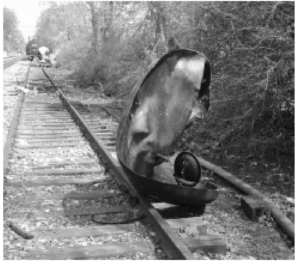
The 316 stainless steel pressure vessel involved had been moved into the Commonwealth of Kentucky approximately ten years prior to the accident. The vessel had originally been used as an atmospheric vessel in the manufacture of ammonium bisulfite, a raw material for caramel color, and later converted to be used as a pressurized unit. The tanks were operated at atmospheric pressure...
Read More
At a brewery in 1997, an operator confused filling nozzles for two commonly used acid cleaning agents and transferred nitric acid into a tank with P3, a proprietary phosphoric acid based cleaner that also contained 5-15 percent isopropanol. 10-15 minutes later the mixture exploded violently. The stainless steel tank disintegrated with such force that fragments lodged in walls of concrete. The explosion...
Read More
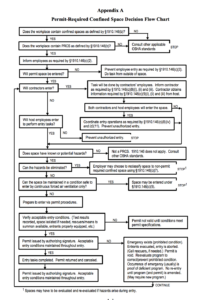
A couple of weeks I posed this question, and I figured there is NOT a consensus among the safety community (including OSHA) as to whether (c)(5) AND (c)(7) can be used on the same PRCS at the same time. My position is NO, they can not be; but I am only one voice in the debate, and many excellent safety professionals have spoken up and said YES. I know it is not clear if we read all...
Read More
A few months ago I wrote about this new refrigerant as having the catastrophic risk of a BLEVE event. Now I wish to offer some guidance on how a business utilizing this refrigerant can reduce the likelihood of this type of event. First, there are NO engineering standards that guide a manufacturer of an ASME pressure vessel in how to construct a pressure vessel so that it will not fail in a BLEVE...
Read More

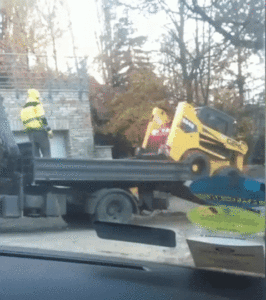
This is what happens when we load heavy equipment like fools. Too many videos of “succesful” (although foolish) attempts at loading this type of equipment into the back of trucks UNSAFELY and now it seems everyone thinks they can do it. Here is a failure mode that one would think would cross the worker(s) minds before attempting…
Read More
Respondent has five RMProgram covered processes. The letdown area process, the urea process, and the high pressure solutions process store or otherwise use ammonia in an amount exceeding its applicable threshold of 10,000 pounds; the chlorine addition process stores or otherwise uses chlorine in an amount exceeding its applicable threshold of 2,500 pounds; and the sulfur dioxide addition process stores...
Read More
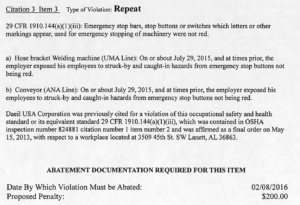
We dont see this citation very often, but it is a standard and it is one that we use often…
1910.144(a)(1)(iii) Stop. Emergency stop bars on hazardous machines such as rubber mills, wire blocks, flat work ironers, etc., shall be red. Stop buttons or electrical switches which letters or other markings appear, used for emergency stopping of machinery shall be red.
Here is an OSHA citation...
Read More
As we know, 1910.146 gives employers three (3) methods to enter Permit-Required Confined Spaces:
1) Full permitted entry following (d)-(k),
2) alternative entry methods prescribed in (c)(5), and
3) reclassification of the PRCS to a non-permit space by following (c)(7).
However, in the past year or so, we have come across another method… using BOTH (c)(5) AND (c)(7) in the same space at the same...
Read More
This incident is a PERFECT example of what can happen when STORED ENERGY is overlooked. For energy sources like hydraulics and pneumatic (e.g., gases), merely closing a valve and locking it closed or locking out a pump is NOT full energy control. Procedures MUST include the means to dissipate the stored energy to the Zero Energy State (ZES). Keeping in mind that sometimes the dissipation...
Read More
Respondent is a corporation authorized to do business in the State of Texas. Respondent owns and operates a chemical building, manufacturing, and packaging facility. Respondent receives bulk raw chemicals, including liquid sodium chlorite, delivered in tanker, railcar, and packaged containers. Respondent uses these raw ingredients to produce finished products. Liquid sodium chlorite is an extremely...
Read More