












On June 28, 2026, a fatal farming accident occurred in Crane Township, Paulding County, Ohio, involving a tractor pulling an anhydrous ammonia “nurse” tank. The farmer, 59, was killed. He was driving a John Deere 9220 tractor pulling an anhydrous ammonia tank through a field. Just after 4:00 PM, the machinery struck and crashed into a large ditch. The impact ruptured the nurse tank, causing...
Read More
On May 27, 2025, a catastrophic explosion and fire erupted at a chemical manufacturing plant operated by Shandong Youdao Chemical Co., Ltd. (often referred to as Gaomi Youdao Chemical) in Gaomi City, Shandong Province, China. The explosion killed 12 people, injured 19 others, and caused widespread structural destruction throughout the surrounding area.
In July 2026, the Shandong Provincial Government...
Read More
For a formal liquid bubble leak test using a detector like Swagelok Snoop, the industry-standard minimum pressure governed by ASME Section V, Article 10 and ASME B31.3 is 15 psig or 25% of the system design pressure, whichever is less. While SNOOP itself will bubble at virtually any positive pressure where gas escapes, engineering codes specify pressure thresholds to ensure sufficient velocity and...
Read More
As we have discussed before, the PREFERRED pressure/leak testing method is hydrostatic. This is the “rule” for all of the ASME B31 series RAGAGEPs; however, for some odd reason, many businesses believe that pneumatic testing is “easier, cleaner, and cheaper” and will just perform their testing with little to no consideration for using hydrostatic methods. But B31.9, Utility...
Read More
It’s an internal OSHA term for when an employer chooses to use TagOut (TO) instead of LockOut (LO). The TO has to be “equally effective” as a LO; this “Tag Plus” must be demonstrated to show that the TO is equal to an LO.
…
HomeRead More »
Read More
The Industrial Safety and Health Department has directed all seafood processing units to relocate labor quarters to safe locations from the processing units immediately. The order comes in the wake of the NH3 leak tragedy that left 18 workers dead, as their accommodation was in close proximity to the factory’s Engineroom. Following the incident, the state formed a high-level committee to inspect...
Read More
ABSOLUTELY NOT! I know this may not be accepted by everyone, but the medical questionnaire is a medical record, and even the safety manager does not have access to it. In fact, some of the companies I worked for forbade the record from being kept on site. Although two of my sites had on-site medical with nurses and a company physician, those were different situations. But in a smaller facility...
Read More
Employees who refuse to undergo a medical evaluation cannot be assigned to work in areas where they are required to wear a respirator.
…
HomeRead More »
Read More
In the past 12-months I have been told by three (3) organizations that I can not audit the fit testing records because they are “personal medical records”. After some time, I finally convinced their legal team that fit tests are not medical records, and I was then allowed to audit the records. And of course, each time I found issues with methods and records.
Does anyone else refuse 3rd-party...
Read More
The Respiratory Protection (RP) standard medical questionnaire for 1910.134 will NOT satisfy the HAZWOPER medical surveillance requirement. The intent and requirements for medical surveillance under HAZWOPER are very different from those required by the Respiratory Protection standard. The intent of the HAZWOPER medical surveillance requirements are two-fold:
…
HomeRead More »
Read More
Fireproofing piping supports — specifically the application of Passive Fire Protection (PFP)— is a critical mitigation strategy designed to prevent the structural collapse of pipe racks during a flammable liquid fire. In most state fire codes and the IFC, flammable liquid piping supports inside a secondary containment are REQUIRED to be protected from the effects of a pool fire.
…
HomeRead...
Read More
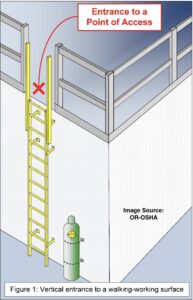
The simple answer is yes. Federal OSHA requires either a self-closing swing gate or an offset barrier at the point of access where a fixed ladder meets the unprotected edge of a walking-working surface. While the regulatory text in Subpart D sometimes causes confusion by referring to these access points as “holes,” OSHA consistently enforces the gate requirement at perimeter edges to maintain...
Read More