






I am sure this article will ruffle a few feathers, but honestly, I am surprised and disappointed by that. But I do a lot of work in flammable liquid processing, and this topic always comes up during audits, PHAs, and accident investigations. Some folks will swear that only grounding is “required.” They get this from OSHA’s 1910.106(e)(6)(ii) Grounding section. However, although...
Read More
Source
Corrosion Rate or Degree of Corrosion
Remaining Life or Fitness for Service
Application
API 570
Long-term (between last and initial inspections):
(use corrosion rate resulting in shortest remaining life)
Piping
Short-term (between last and previous inspections):
Piping and Vessels
NBIC – 23
a) calculated from data collected by owner or...
Read More
Comparison of Piping Inspection Requirements in Refrigeration Industry
Code
Component Description
Inspection
Remediation
Inspection Frequency
IIAR 109 (1997)
Uninsulated Pipe (4.7.4)
Examine for corrosion
Clean pipe down to bare metal and paint with rust preventative paint.
“Badly corroded pipe should be replaced.” (4.7.4)
– Annual ammonia safety...
Read More
Comparison of Pressure Vessel Inspection Requirements in the Refrigeration Industry
Code
Type of Inspection
Component Description
Inspection
Remediation
Inspection Frequency
IIAR 109 (1997)
All pressure vessels
If signs of more than mild corrosion should inspect further by a professional engineer or ASME inspector (4.3.5)
None listed
– Annual ammonia safety...
Read More
The following are all the “exemptions” permitted in EPA’s Risk Management Plan rule (40 CFR PART 68—Chemical Accident Prevention Provisions)
…
HomeRead More »
Read More
In process safety, we deal with a lot of pressure vessels and even some boilers. It took me years to understand the differences between the U-1, P-2, and P-3 forms and all the requirements for the placement and management of these pressure-retaining containers. This article is intended to help safety pros who may have to deal with these types of pressure-retaining containers; so this is a 30,000-foot...
Read More
Below is OSHA’s official position on the need for hydrostatic relief valves in an Ammonia Refrigeration process. This is a bold move on OSHA’s part as the Ammonia Refrigeration industry and their trade groups have consistently stated that a “trained operator” is better than a hydrostatic RV.
(emphasis added by me)
…
HomeRead More »
Read More
I recently worked with a client on their emergency response efforts, and we continue to find businesses that do not understand the different requirements of qualifying a worker to use a respirator under CONTROLLED workplace exposures vs. UNCONTROLLED emergency response exposures. So, I wanted to write this article to make it as straightforward as possible…
Employee A is hired into a job...
Read More
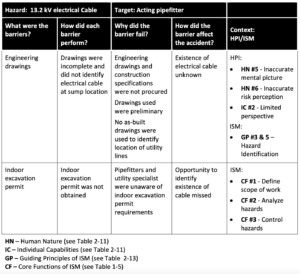
When analyzing barriers, investigators should first consider how the hazard and target could come together and what was in place or was required to keep them apart. Obvious physical barriers are those placed directly on the hazard (e.g., a guard on a grinding wheel); those placed between a hazard and target (e.g., a railing on a second-story platform); or those located on the target (e.g., a welding...
Read More
One of my favorite examples of Human Factors Engineering is the Center High-Mounted stop Lamps. We have all seen them on every personal vehicle manufactured today. They are now a safety requirement. But it was not always that way. So, what is a CHMSL? CHMSL are red stop lamps mounted on the center line of the rear of a vehicle, generally higher than the stop lamps on the...
Read More
Retail facilities are exempted from PSM requirements. At first glance, it appears this is a pretty broad exemption, as the standard just states.
This section does not apply to:1910.119(a)(2)(i) Retail facilities;
But as I wrote about last month, not all retail facilities selling a PSM Highly Hazardous Chemical (HHC) in the USA are exempt. In 2010, the state of Oregon began covering retail businesses...
Read More
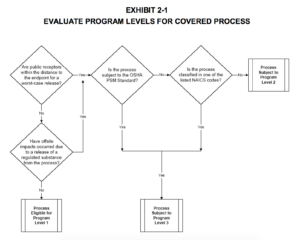
As we have discussed before, the EPA broke down its RMP rule into three (3) programs, and each program has criteria that will place the process in one of the three. However, the one criterion that confuses some businesses is how the EPA used the North American Industry Classification System (NAICS) to qualify a process for Program 3. Here is what the RMP rules state.
…
HomeRead More &ra...
Read More