












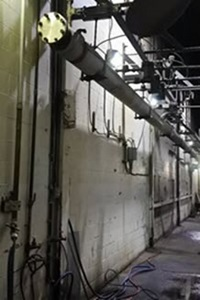
In a steam plant at a plywood mill, two (2) workers were attempting to replace a leaky nipple and gasket at the end of a condensate header. As they were loosening or removing nuts from the outer flange at the end of the header, one worker was sprayed with steam and condensate (hot water). The worker sustained serious injuries.
…
HomeRead More »
Read More
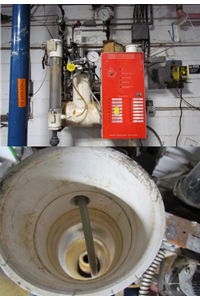
At a poultry-processing plant, a worker (engineer) was responding to an ammonia leak from an air purger (equipment that removes air and other non-condensable gases from the refrigeration system to improve efficiency). He described the signs of the problem to a refrigeration mechanic over the telephone. While waiting for the mechanic to arrive, the worker was splashed with ammonia-saturated water (ammonia...
Read More
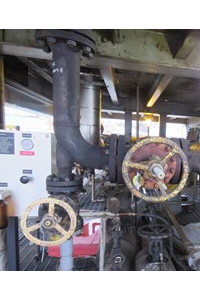
A worker on a contracted maintenance crew at an oil refinery partially unbolted a flange on a live crude oil heat exchanger. An undetermined volume of oil was released. Another worker, a refinery employee who participated in the incident response, was exposed to the resulting crude oil vapors, which are believed to have contained hydrogen sulfide (H2S). The second worker sustained injuries from the...
Read More

An auto repair worker was walking toward his mobile service vehicle, which contained an oxyacetylene welding system, to start work for the day. When he was approximately 32 ft. away, he clicked a button on the key fob to unlock the vehicle remotely. The vehicle immediately exploded and burst into flames. No one was injured in the explosion; however, surrounding vehicles and property were extensively...
Read More

To accurately understand pressure measurements in industrial safety and process engineering, it is essential to distinguish between absolute pressure and gauge pressure, as well as the units commonly used for low-pressure monitoring (such as draft gauges or vacuum systems).
The following table provides the conversion relationships between these units, referenced against standard atmospheric pressure...
Read More
I have worked with three (3) organizations in the past 5 years on their efforts to make H2 an everyday fuel for household appliances, vehicles, and industrial fuels. Each project was a huge learning experience for everyone! But I am a lover of “codes” to establish the baseline design, construction, operation, and maintenance. I looked to my IFC for guidance, and I was not let down....
Read More
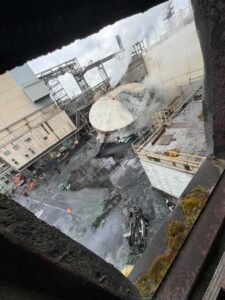
We keep hearing how the tragedy in WA state at the Papermill was some type of tank implosion and then explosion. I have serious doubts about that theory. I think this was just a simple seam/weld failure, possibly caused by Stress Corrosion Cracking (SCC), but I am sure the CSB will get to the bottom of this failure in due time. I come to this conclusion based on all the pics and videos we’ve...
Read More
An odor incident at the Gallipolis Water Treatment Plant was triggered by the accidental mixing of two treatment chemicals during a delivery. The incident was isolated entirely to the plant, and officials confirmed there was no threat to the public water supply or drinking water.
Incident Breakdown
Date & Time: The incident was reported to 911 at approximately 11:24 a.m.
The Cause: Water...
Read More
So I was curious as to how a 900,000-gallon white liquor tank could catastrophically fail. I am certain we will learn how this specific failure occurred, but I am not convinced the learnings will be shared broadly if the CSB does not get involved. With this much damage to people and property, there will be a desire to contain as much information as possible, which will not be flattering to the business....
Read More
In the context of a Safety Management System (SMS), auditing is the systematic, independent, and documented process for obtaining objective evidence and evaluating it against established criteria to determine the extent to which requirements are fulfilled.
I recently had a lengthy discussion with the executive team regarding my PSM/RMP audits over the years. These men and women are at the highest...
Read More
A ship’s engineer sustained cold burns to 10–13% of his body surface after liquid propane was released without warning in the early hours of 1 November 2018 during loading operations. A flammable gas cloud could have resulted in a catastrophic explosion if ignited. The worker was treated at the hospital and subsequently repatriated to Russia, where he received further treatment. He is understood...
Read More
We get so much slack when we push Hydrostatic Pressure/Leak Testing vs. Pneumatic testing. So many think that pneumatic is easier and cheaper, when in reality it is NOT. In fact, the B31 series makes it clear that HYDROSTATIC is the first choice for pressure and leak testing. The code makes it clear that pneumatic is for when the piping pressure and leak test can NOT be done by the hydrostatic method...
Read More