








As we have discussed, OSHA does not have a “flammable gas” standard for those flammable gases outside the scope of its Liquefied Petroleum Gas (LPG) standard 1910.110. So in most of my work with flammable gases, I will use 1910.110 or NFPA 58 as my RAGAGEP. I do this as many facilities already have some fundamental understanding of LPG hazards. This all starts with “siting”...
Read More
It is difficult for engineers to change human nature and therefore, instead of trying to persuade people not to make errors, we should accept people as we find them and try to remove opportunities for error by changing the work situation — that is, the plant or equipment design or the method of working. Alternatively, we can mitigate the consequences of error or provide opportunities for recovery.
Source:...
Read More
I have been surprised at our profession’s lack of basic understanding regarding pressure and vacuum. I think most people of the general public have no idea that we live under 14.7 pounds of pressure per square inch on our bodies. We say this is what it is at SEA LEVEL, which means a lot. As with the recent catastrophic implosion of the submersible, it was well BELOW “sea...
Read More
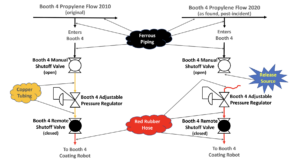
The incident occurred shortly after 4:30 am on January 23, 2020, when an accidental release of propylene accumulated and exploded inside the building. The CSB found that before the incident, a hose disconnected from its fitting inside a coating booth and released propylene, a flammable hydrocarbon vapor, which accumulated inside the coating building. When employees arrived at the facility early on...
Read More
If you want to have some fun VALIDATING the Hazard Identification element of your SMS/Safety Process, use some of these cartoons or real images in a fun but eye-opening exercise.
Get a group together, show the cartoon/image, and have the group (but individually) identify all the hazards they can recognize in the cartoon/image.
Then we analyze the VARIATION in what was recognized and what was not...
Read More
As I rant on about validating and verifying our safety data and defining and quantifying our safety processes, I wanted to share another incident where we learned the hard way. I managed a chemical facility with many corrosives; thus, eyewashes and safety showers were important items in the mitigation layer. And as most of us have experienced, these items had a shady history of their weekly...
Read More
Whether it is on leading or lagging data, data validation and verification is a MUST if we want to build a solid SMS.
Making decisions on bad (unverified/unvalidated) data leads to bad decisions, or worse – inaction in risks as leadership may believe all is well.
…
HomeRead More »
Read More
This article was written by Carsten Busch, Safety Mythologist and Historian. The “Indiana Jones of Safety.” Experienced safety, quality, and productivity enabler. [email protected]
It was translated from Dutch to English using Google Translator and Grammarly. I follow Carsten on LinkedIn as he, too, is a defender of H.W. Heinrich. He was kind enough to allow me to share...
Read More
The state of NY is removing its code requirements for Ammonia Refrigeration processes and simply requiring the use of IIAR standards…
…
HomeRead More »
Read More
In 2021, the EPA published a Joint Safety Advisory with the Occupational Safety and Health Administration and the Department of Homeland Security Cybersecurity and Infrastructure Security Agency, focused on managing chemicals safely, securely, and in compliance with federal programs for Chemical Warehousing and Chemical Distribution Facilities.
In this video, we will address the types of operations...
Read More
If we want to understand why the activity of operators has a particular characteristic, it is often necessary to look for reasons other than those that are immediately visible.
The operator working on an aspect of the process is placed in a working environment that will play a part in determining his/her activity and, therefore, his/her observable behavior.
If we take a photograph of him/her, some...
Read More
This advisory clarifies roles and responsibilities for the safe operation and maintenance of registered unattended ice surface refrigeration plants in accordance with the Operating Engineers (OE) regulation (O. Reg. 219/01 or “the regulation) and the corresponding Director’s Order and any applicable OE Alternate Rules.
Unattended refrigerated ice surfaces are an important part of Ontario’s recreational...
Read More