













A worker performing maintenance inside a cement mixer at a concrete manufacturing company narrowly escaped fatal injuries when a co-worker turned the machine on. An OSHA investigation determined that the company’s failure to comply with federal workplace safety standards nearly cost the worker their life.
OSHA learned management knew that federal law required the company to train workers on lockout/tagout...
Read More

The Respondent operates a frozen poultry storage facility adjacent to other businesses, within several hundred feet of residences, and near a hospital. Respondent uses anhydrous ammonia in a refrigeration “process,” as defined by 40 C.F.R. § 68.3, in a system of pipes and vessels at the Facility (the “Process”). On June 5, 2019, EPA inspectors visited the Facility to assess...
Read More
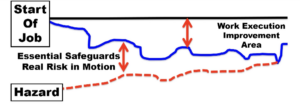
This single image captures all we need to recognize about “real-world safety.”
The straight black line represents “work as imagined”; this means the work done “by the book” every time. Anyone who believes humans follow all the rules 100% of the time is living in a fantasy land. We are wired to find the easy, most efficient, and fastest way to do things. ...
Read More
On February 8, 2017, an explosion at the DeRidder Mill killed three contract workers and injured seven others (the “Explosion”). These workers from Elite Welding, LLC (“Elite”), were welding on the cracked intersection of a vertical eight-inch clean condensate pipeline and a three-inch pipeline near the Mill’s 100,000-gallon foul condensate tank. This tank accumulates harmful vapors, referred to as...
Read More
On August 12, 2016, hot work was being conducted by a contractor at a crude oil terminal on a section of pipe that contained residual crude oil. Using an isolation device, the pipe segment was plugged on both ends by a sub-contractor (hired by the primary contractor). During the welding operation on the inside surface of a flange, vapor inside the pipe gathered between two of the installed isolation...
Read More
Safety is a privilege to protect our teams. But you better F’ing respect that privilege and honor it. There is no higher calling than what we get to do day in and day out. If this is a job for you – get the hell out of our way and find something else to spend your time doing. This is a passion to most of us – sure, we get paid, we have families to care for. But we do this because we CARE...
Read More
OSHA has an actual policy of “Corporate Name Shaming.” It is a horrible practice and harms OSHA’s credibility, as all “shaming” programs do. But they continue it as if it makes a difference. What amazes me is that some companies still do the same thing to their employees. As the title of this article makes clear… the FIRST and possibly...
Read More
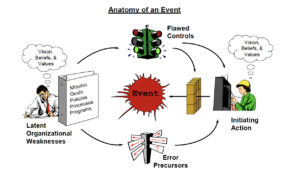
A traditional view of events and accidents is that they are caused by human competence, attention, or attitude shortcomings. It may be under the label of “loss of situation awareness,” “procedural violation,” or “poor management”. A new and different view is that human error is NOT the cause of failure but a SYMPTOM OF FAILURE – trouble deeper inside the system. Human error is not...
Read More
Recently, several fires occurring during hot work have been reported to BSEE. Hot work is any job with the potential to create an ignition source, such as an open flame, sparks, or high temperatures. Examples of hot work include welding, using acetylene torches, and grinding and cutting metal.
…
HomeRead More »
Read More