











Temporary Equipment as a Potential Source of Ignition on Offshore Facilities (BSEE Safety Alert 449)
Bureau of Safety and Environmental Enforcement field personnel have indicated a need for increased operator awareness when using temporary equipment (TE). Some TE may be a potential ignition source and can range from small items such as portable welding sets to large skid-mounted packages (e.g., temporary generators, air compressors, hydraulic power packs, well-testing equipment, process equipment,...
Read More
In my discussions with SAFTENG members who are Process Safety clients, the question is always asked: “Where do you get the terms “responding facilities” and “Non-Responding facilities” from? These are terms used in EPA’s Risk Management Plan rule, and I have said many times in my writings that not every facility is required to have an emergency response...
Read More
Respondent has a synthetic rubber manufacturing process at the facility that processes two petrochemicals, butadiene and styrene, and the temperature of the reaction is controlled by anhydrous ammonia. Respondent has greater than a threshold quantity of 1, 3-Butadiene and Ammonia (anhydrous) in a process at the Facility, meeting the “covered process” definition defined by 40 C.F.R. § 68.3.
Complainant...
Read More
Respondent is the current operator of a chemical manufacturing and distribution facilities. The General Duty Clause applies to any stationary source producing, processing, handling, or storing regulated substances, as defined above, or other extremely hazardous substances (“EHS”). EHSs include regulated substances listed pursuant to Section 112(r)(3) of the Act at 40 C.F.R. § 68.130 and chemicals on...
Read More
The requirement to issue a hot work permit, including documentation of necessary fire protection and prevention measures, is currently in the RMP regulation only for Program 3 processes. Under 40 CFR 68.85(b), “The permit shall be kept on file until completion of the hot work operations.”
Under the existing RMP regulations, it can be difficult for implementing agencies to determine if the facility...
Read More
EPA initially looks to the latest version of industry codes, standards, and guidelines to determine whether an owner or operator has documented compliance with RAGAGEP under 40 CFR 68.65(d)(2), given that 40 CFR part 68 does not define the phrase “recognized and generally accepted good engineering practices.” EPA believes this application makes sense because the plain meaning of the phrase is that...
Read More
The current definition of “retail facility” at 40 CFR 68.3 is “a stationary source at which more than one-half of the income is obtained from direct sales to end users or at which more than one-half of the fuel sold, by volume, is sold through a cylinder exchange program.”
The period of sales to end users is unclear; it lacks a definite time frame to calculate whether more than one-half of the facility’s...
Read More
Currently, under 40 CFR 68.3, the term “stationary source” does NOT apply to transportation activities, including storage incident to transportation for any regulated substance or any other extremely hazardous substance. A stationary source does include transportation containers connected to loading/unloading equipment or used for storage, not incident to transportation. Still, the term “storage,...
Read More
The new criteria include violations of all hazards and OSHA standards and will continue to focus on repeat offenders in all industries. Previously, an employer could be in the program for failing to meet a limited number of standards. The changes will broaden the program’s scope with the possibility that additional industries will fall within its parameters. Specifically, the updated criteria...
Read More
A 48-year-old worker entered a tanker trailer to inspect it as part of an annual U.S. Department of Transportation requirement and was overcome by exposure to bleach and chlorine gas. The worker was found unconscious in the tanker trailer, and he later died of his injuries.
An investigation by OSHA determined his employer failed to identify and evaluate atmospheric hazards in the confined space, train...
Read More
The respondent’s facility (“Facility”) is located in a mixed-use area. The Facility is located on the third and fourth floors of a mixed-use commercial/industrial building that houses medical offices, a deli, and other businesses. The Facility is located within a third of a mile of several tourist attractions, including museums and restaurants. The east end of the building abuts the...
Read More
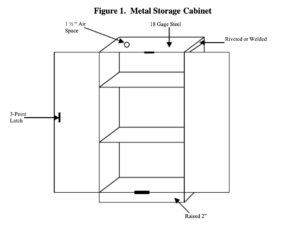
Another great review on the design, construction, and capacity of flammable storage cabinets, a topic that seems never to go away.
Safety Tip: Single-walled supply cabinets do not work.
…
HomeRead More »
Read More