












The April 2022 incident that was reported as “two (2) men down on the property” was actually a PRCS accident involving a railcar at the repair facility. IN-OSHA released its findings last month and issued $113,400 to the business. One worker passed away, and the other survived. Here is a breakdown of IN-OSHA’s PRCS citations:
…
HomeRead More »
Read More
On April 21, 2021, two employees were working inside a rail tank car that had previously contained pressurized propane. The two employees were conducting ultrasonic testing on the welds of the interior of the tank car. Employee one exited the tank manway and expressed concern that he was starting to smell something. Employee three, the attendant, immediately told employee one that he and employee two...
Read More
Nevada OSHA adopted regulation R069-20, which includes the adoption by reference of ANSI Z358.1-2014 for Emergency Eyewash and Shower Equipment. By adopting ANSI Z358.1-2014, Nevada OSHA has identified the minimum design and installation criteria necessary to meet the definition of suitable facilities, which is otherwise undefined in federal statute. Additionally, training requirements have been...
Read More
Employee #1 attempted to replace a leaking oil valve on a minus 30 degree freezer when a tank inside the freezer exploded. The company uses anhydrous ammonia to manufacture ice cream. The liquid ice cream mixture (at 50 degrees) is added to the tank. This freezer was down for seven days, and the tank’s oil had congealed. Normal weekly maintenance requires the removal of used oil through the oil...
Read More
Employee #1 was working for a firm that, as a subcontractor, performed maintenance on commercial food service equipment. He was in the kitchen area of a single-story restaurant, attempting to locate the source of a refrigerant leak in an ice cream storage dipping cabinet. Employee #1 connected a cylinder containing pressurized nitrogen to the dipping cabinet’s refrigeration system via a hose...
Read More
At approximately 9:50 a.m. Employees #1 and #2 worked as mechanical engineering technicians at a food cold storage facility. The two workers were troubleshooting an Auto-Purger. The Auto-Purger removed non-condensable material from the refrigeration system. It was mounted on a wall inside the facility’s anhydrous ammonia compressor room. At the time of the accident, the unit was actively running...
Read More
Employees #1 and #2 were draining refrigerant oil from anhydrous ammonia refrigeration system oil traps in fruit cold storage warehouses. They were working approximately 24 feet above floor level on a mobile scissor lift personnel platform (Hyster, V24) using hand tools, including a wrench, a flashlight, and a bucket. The cause of the unexpected ammonia release is unknown.
Employees #1 and #2 suffered...
Read More
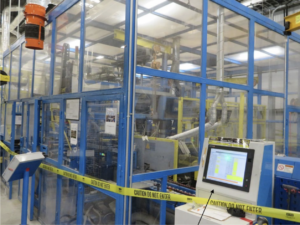
A 48-year-old male employee was crushed inside a machine (COS) while adjusting the grippers that place lead cells into batteries. This employer is a battery manufacturer. On the day of the incident, the victim was called by the machine operator to troubleshoot the COS machine because the grippers were not working. It was determined that the operator would attempt to make the adjustments through manual...
Read More
I have walked by hundreds of these “misters” and never considered this hazard! A 59-year-old male employee contracted legionnaires disease from exposure to water from a cooling mist fan while working in the banbury/mixing area. This company manufactures tires for consumers, automotive and commercial vehicle original equipment manufacturers, and the agricultural, forestry, and mining...
Read More
At 4:45 p.m. on August 14, 2015, Employee #1, a maintenance worker, was lowered into a 12-foot tall 8,000-gallon polyethylene tank using a rope with a loop to stand on and the other end connected to a rough terrain forklift operated by the manager of the farm. The tank was used to store liquid whey added to the animal feed. Employee #1 was instructed to open a broken ball valve so the liquid whey would...
Read More
At 9:30 a.m. on November 8, 2015, an employee was cleaning the inner lining of a railcar that was previously transporting latex. The employee lost consciousness while inside of a railcar with an oxygen-deficient atmosphere. First responders attempted to rescue the employee but could not revive/resuscitate them. A second employee who entered the railcar lost consciousness and was rescued and transported...
Read More
At 2:30 p.m., Employee #1, Employee #2, and Employee #3 were tasked with dismantling a scaffolding level within a containment dome (identified as PMDI A-3600). During their dismantling work, at approximately 80 feet above the ground, alarms specific to phosgene gas were triggered. The process within this Dome was the manufacturing and using phosgene to facilitate the production of PMDI (an isocyanate)....
Read More