










In section 2, element 2.5, of an RMP, facilities must report the quantity of toxic chemical that the facility used for the worst-case analysis. When reporting this data element in RMP*eSubmit for a mixture, should facilities report the entire weight of the toxic mixture potentially being released or only the amount of the regulated toxic substance in the mixture?
…
HomeRead More »
Read More
If we had a dime for each time we get pushback on the most fundamental aspect of Lockout/Tagout (LOTO), we could all retire! NEVER is an authorized employee allowed to work under someone else lock – PERIOD! When servicing and maintenance that requires LOTO is performed, then EACH authorized worker MUST HAVE EXCLUSIVE CONTROL of ALL the isolation device(s) protecting them.
If...
Read More
At 9:50 a.m. on June 5, 2018, Employee #1 was in an 8 foot by 8-foot pit that was approximately 10 feet deep, cleaning out built-up sediment using a brush and 5-gallon bucket. Employee #1 was being helped by Employee #2, who was dumping the waste outside of the building that the pit was in. Employee #1 finished cleaning out the sediment and brush, got Employee #3 to open up the water gate to allow...
Read More
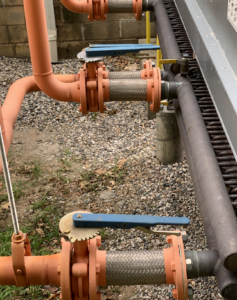
Does your entry procedures/practices allow for “misaligning or removing sections of lines, pipes, or ducts” as a means to isolate a PRCS? If yes, do your procedures/practices specify the length of “sections of lines, pipes, or ducts” that have to be removed in order to meet the intent of “isolation”? I can not recall where it came from, but we always...
Read More
In light of the recent EPA citation at a bulk storage facility for anhydrous ammonia (NH3) I thought it would be fitting to highlight a best practice from the state of Illinois for this type of process. Most states are in the process of updating their state codes for the safe storage and handling of NH3 – IL was just a little bit faster. They have adopted a lot of CGA 2.1, but they...
Read More
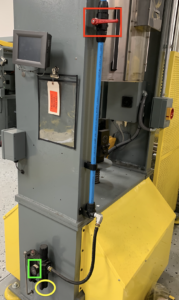
If you have equipment that uses compressed air (CA) as an energy source, you will understand my frustrations with how poorly we manage this hazardous energy source. Typically, compressed air is provided via a plant-wide header system with drops for machine/equipment. These drops will then use a hose to deliver the compressed air to the machine/equipment, much like my picture below. ...
Read More
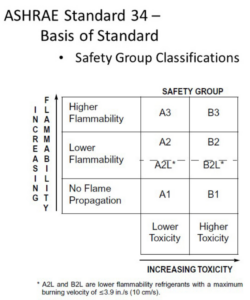
If you have read your meter’s manual you have most certainly come across it’s “correction calculation”, usually in the back of the manual. But Isobutane is not a common flammable, so why did it make it on the list of those popular flammables? It is because of the “green movement”… yes, Isobutane (R-600a) is a popular refrigerant for small appliances. ...
Read More
Respondent stores and uses ammonia at the facility in parts of the storage and refrigeration process. Respondent’s storage and refrigeration process contains more than the threshold quantity (10,000 pounds) of ammonia. Respondent’s storage and refrigeration process does not meet the eligibility requirements for Program 1 under 40 C.F.R. § 68.10(b) and is subject to the OSHA process safety...
Read More
SPECIAL NOTE: This is the first time I have seen a penalty reduction from the COVID-19 impacts on the business.
Respondent operates an ammonia refrigeration process with 15,416 pounds of anhydrous ammonia. The Respondent has one RMProgram level 3 covered process, which stores or otherwise uses a toxic substance in an amount exceeding its applicable threshold of 10,000 pounds. On December 11,...
Read More
I am sharing this OSHRC decision to demonstrate how a citation can be vacated with PROPER supervision and training on machine hazards, guarding, and LOTO. In this case, an employee opened a guard, reached into the machine to clean/clear breading and the machine started – grabbed his smock and caused serious injuries to his right arm and hand. The business won BOTH times (in front...
Read More
LOTO locks can be keyed alike. For example, equipment/field locks can all be keyed to a SINGLE key; however, personal/individual locks MUST BE individually keyed (e.g., 1 key – 1 lock). Before starting work ask yourself this simple but very important question: Do I have EXCLUSIVE/SOLE control of each and every isolation device protecting ME?
This is the fundamental premise...
Read More
Respondent owns and operates a beet sugar manufacturing facility.
…
HomeRead More »
Read More