









Respondent is the owner and operator of a facility where on October 13, 2019, there was an incident at the Facility that resulted in an accidental release. On April 4, 2020, the EPA requested, and Respondent provided, documentation and information concerning the Incident and Respondent’s compliance with Section 112(r) of the CAA and 40 C.F.R. Part 68. Corroded piping caused a leak of approximately...
Read More

It has been 36 years since the Bhopal tragedy killed thousands of people late one night when it was released from its process. I was recently surprised by a facility claiming that the incident was “overblown” and that “MIC is a vital chemical to commerce around the world”. I can’t disagree with the second statement, but I got myself in trouble pushing back...
Read More
Both OSHA and the International Fire Code use the Lethal-Dose 50 (LD50) to establish the toxicity of hazardous chemicals/materials and both use the metric milligram per kilogram of body weight in their assessments. Just so we all have an idea of how small a milligram is…
One (1) grain of sand weighs 1 mg
An average-sized ant will weigh around 2 mg
So we are talking about some REALLY toxic...
Read More
We have been using OSHA’s Hazard Categories from the Globally Harmonized System of Classification and Labelling of Chemicals (GHS) since 2012. I have written a lot about the flammable categories, but I tend to get a lot of questions about the Health Hazard Categories in my HAZCOM and HAZMAT training so I thought I would explain in real-world terms how toxic some chemicals are using...
Read More
Two of my major chemical incidents in my career occurred during “demo work” in a process that we were certain was gas-free/zero energy state. And of course, we were wrong! Highly toxic/flammable gases can travel long ways to places we never thought possible and do some serious damage to people and property when they get released. Here is an OSHA case where the workers...
Read More
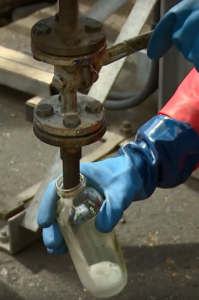
Just because we intend to handle minimal quantities of the HHC/EHS, the task of “catching a sample” from a covered process can, in fact be one of the more hazardous tasks our operators perform. Remember, Risk = Frequency X Severity, so operators catch many samples over their shift means this task is a high-frequency task. And as the picture below shows us, we need to ENSURE...
Read More
Respondent is a Gourmet Pasta Company that uses anhydrous ammonia in two refrigeration “processes,” as defined by 40 C.F.R. § 68.3, in two separate systems of pipes and vessels at the Facility (the “Processes”). On October 12, 2016, Respondent conducted a Process Hazard Analysis (“PHA”) for the Facility. On March 30, 2017, Respondent filed an update of its RMP with EPA. Respondent’s RMP categorizes...
Read More
I am going to bet that if you’re reading this article that your facility has a flammable gas that gets transferred from one container to another. And I will also bet that these transfers are done under the safety blanket of “bonding and grounding” as we do for our flammable liquids. But did you know, most flammable GAS transfers do not call for bonding and grounding –...
Read More
Respondent is the owner and/or operator of a facility that uses chlorine in its chemical manufacturing process. EPA conducted an inspection of the Facility on November 29, 2017, to assess compliance with Section 112(r)(7) of the CAA (the “Inspection”) and the regulations at 40 C.F.R. Part 68. Respondent filed an RMP for the Facility with EPA on January 26, 2017, that, among other things,...
Read More
This Notice of Violation is being issued by the New York State Department of Environmental Conservation (Department) to SABIC Innovative Plastics US, LLC in response to the unauthorized release of styrene vapor on September 1, 2020 at the facility. According to information obtained by the Department in conducting its on-going investigation of this incident, on September 1, 2020, an estimated quantity...
Read More
Pursuant to the risk management program regulations, facilities must perform an offsite consequence analysis for the worst-case release scenario. Do the quantities of two separate vessels that are interconnected with a closed valve need to be aggregated for the worst-case release scenario analysis?
…
HomeRead More »
Read More
For the purpose of analyzing the worst-case release scenario required as part of the hazard assessment at 40 CFR Part 68, Subpart B, the worst-case release quantity is identified as the greatest amount held in a single vessel or pipe, taking into account administrative controls that limit the maximum quantity (40 CFR §68.25(b)). Are mechanical controls such as alarms considered administrative controls...
Read More